Built for autistic teens & adults — diagnosed or self-identified

The unwritten rules, written down. Then rehearsed until they're yours.

Every conversation runs on rules nobody says out loud. Subtext writes them down, then gives you somewhere to practice them — with an AI playing the other side, as many times as you want, before you do it once for real.

🔒 Nobody sees attempt one. Everything stays on this device unless you choose to sign in.

Opens in your browser · No account, no download · Nothing you type leaves your browser

Why are you looking?Job interview
I'm not sure I'm ready to leave my current role, honestly.
That's fair — what would make it feel worth the jump?
ScriptedAbout 5 minutes1 other personStop any time
On-device first No API key required Designed with autistic adults Nothing shared by default
The problem

The world runs on rules nobody writes down.

How long to hold a handshake. Whether "we should hang out sometime" is an invitation. When a manager's "suggestion" is actually an order. Most people absorb these rules without noticing. Autistic people are expected to reverse-engineer them — usually by getting one wrong, in public, with something real at stake.

The research is clear that this is a translation problem, not a broken-person problem: autistic-to-autistic communication works just fine (the "double empathy problem," Milton 2012; Crompton 2020). But the practical cost of the mismatch still lands on autistic people — and it compounds:

Age 22
the services cliff: school-based support ends, and roughly a quarter of autistic young adults then receive no services at all
Drexel National Autism Indicators Report
~21%
of autistic young adults hold full-time jobs — and interviews rate autistic candidates lower on identical answers
Drexel; Maras et al. 2021
4×
higher loneliness rates than non-autistic peers — friendships dissolve on missed signals nobody explains
Autism (SAGE), 2022 systematic review

The rules get taught one of two ways: by a coach, if you can find one and afford the hours — or by getting them wrong in public. Books name the rules but give you nowhere to run them. The apps that do are built for eight-year-olds.

What's missing is a rehearsal space. Somewhere the stakes are zero, the retakes are unlimited, and nobody is watching.

How it works

Read the rule. Run it. Take it with you.

Three moves, in order. You can stop after the first one and still have got something — plenty of people only ever want the rule named.

  1. Read the rule

    With live AI, paste the message you can't parse and get a three-part read: what it literally says, what it probably means, and what a reply could do. Field guides do the same for places rather than messages — what to watch for on a packed convention floor, in a loud brewery, on a suspended train line.

    Decode · Field guides · Decode drills

  2. Run it as many times as you need

    Pick a scenario and the other side is played for you — the interviewer, the manager, the chef shouting over a hot pass — or take a journey and let a story pick each next step. Say the wrong thing on purpose. Back up and try the other line. Ask what would have happened if you'd said nothing at all. The retake button is in the nav bar, not buried in a menu.

    Journeys · Rehearse · Rehearse something real

  3. Take it with you

    Keep the line that worked. See the whole map of scenarios and exactly what leads to what — all of it readable from the start, nothing hidden behind a lock you can't inspect. Log what a day actually cost you, because masking is a cost, not a stat to maximize.

    Scripts · Your Map · Energy

Why it's built this way

Systemising is a strength, not a symptom.

Most social-skills tools start from the premise that something about you needs correcting, then dress it up gently. Subtext starts somewhere else: the rules are real, they are learnable, and the instinct to study them properly is the right instinct — not a workaround for a deficit.

So the app is built like something worth studying. Scenarios sit on a map with visible edges, so you can see what leads to what instead of guessing. Reading is never locked — you can open any part of it, any time, and know exactly what it asks of you before you commit. Practice is the only thing that unlocks along the way, so nothing lands on you cold.

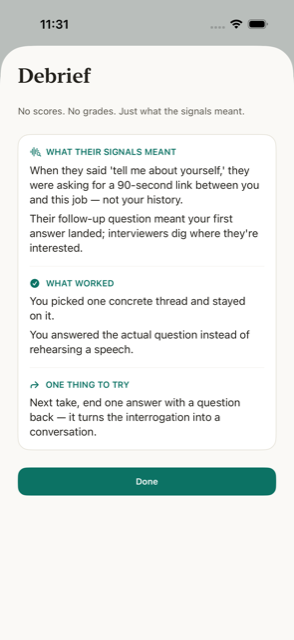
And there is no score anywhere in it. No streak, no grade, no percentage, no red X. The debrief you get is fixed to three things — what your signals meant, what worked, one thing to try — because you have spent long enough being measured against a standard that was never built for you.

Inside the app

What's actually in it.

Nine tools in total — Journeys (stories that pick each next step for you), Rehearse (eighteen scenario packs, from job interviews to packed convention floors and game nights), Decode, Energy, Calm Sound, Decode drills, Scripts, Field guides (step-by-step plans for loud, crowded places), and a Progress feed that's a record, never a scorecard. The four below, straight from the running app.

Rehearse

Practice a real conversation with an AI playing the other side — the interviewer, the manager, the date. Take the same moment again as many times as you want, then get a strengths-based debrief. Three fixed sections, never a score.

The Rehearse debrief screen: what their signals meant, what worked, one thing to try

Decode

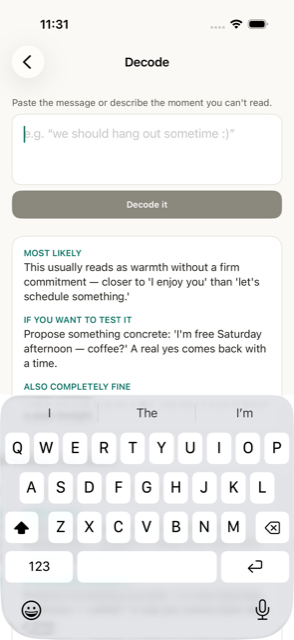
Paste the confusing message, email, or comment, and get the hidden rule stated out loud in plain language — plus a reminder that doing nothing is a completely fine response too. Decode reads your real message, so it needs live AI (a free account).

The Decode screen showing a three-part decode of a confusing message

Energy

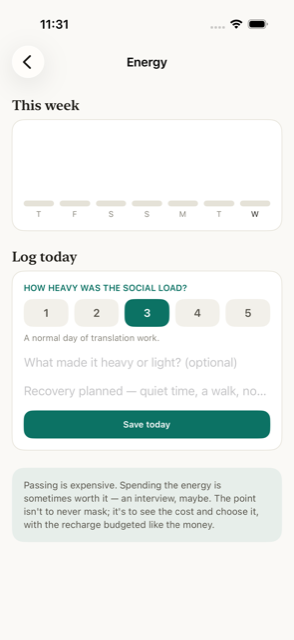
Masking is a cost, not a personality trait. Log the load of each interaction and watch the pattern — so the crash after a good day at work stops feeling like a mystery.

The Energy screen — a week of social load, with recovery notes

Decode drills

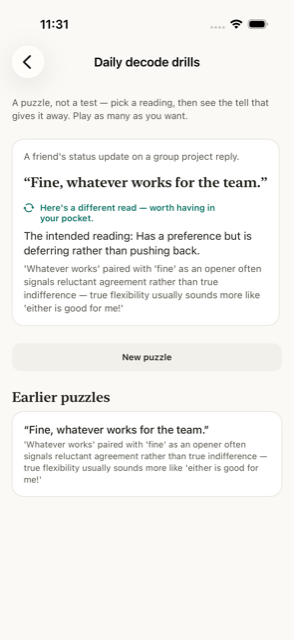
A puzzle, not a test. Pick a reading, see the tell that gives it away. The reveal never says "correct" or "wrong" — that's enforced at the prompt level, not just in the copy. Mastery rounds get harder as accuracy improves, so the skill actually sticks.

A decode drill reveal — your reading matched, or here's a different read
🔒

Nobody sees attempt one.

Subtext runs in practice mode by default — no account, no API key, and nothing leaves your device unless you choose to: signing in (free) saves your practice record to your account so it follows you between devices, and with an account you can turn on live AI, which sends the lines you type to write replies. Awkward drafts, wrong guesses, and bad first tries are the whole point, and they stay private.

Our promise

What Subtext will never do.

"Social skills training" has a deserved reputation problem in the autistic community: too much of it teaches people to perform being neurotypical, and the research links exactly that — masking — to burnout and worse. We built the product so it structurally can't become that.

Never

  • Eye-contact drills, stim policing, or "act more normal" feedback of any kind
  • Scores that grade you against neurotypical presentation
  • Selling or sharing your practice transcripts — ever
  • Puzzle-piece imagery, "overcoming autism" language, inspiration framing
  • Diagnosis gatekeeping — self-identified is welcome here

Instead

  • Neurotypical signals decoded explicitly, like a second language
  • Your goals, your pace — practice is always opt-in and always yours
  • Unlimited private retakes — nobody sees attempt one
  • Masking treated as a cost you budget, never a virtue to maximize
  • Paid autistic co-designers with veto power over every feature and every word of marketing
Why we're building this

The story starts with a cliff.

At 22, structured support for autistic people in the US falls off a ledge. School services end, and what replaces them is a handful of coaches and programs who work with adults — if you live near one, can afford the hours, and can wait out the waitlist.

So the default becomes the only free option: practicing on real life. Every interview is a first take with income on the line. Every friendship is maintained by rules nobody will state. Every mistake is public, and the feedback is rejection. It would be hard to design a worse learning environment on purpose.

Subtext exists because that rehearsal gap is fixable now. The same AI that can hold a natural conversation can play a hiring manager at 11pm the night before your interview — patiently, privately, for the twelfth time in a row — and then tell you, in plain language, what the other person's signals meant. Not therapy. Not treatment. Practice.

We're building it the only way it should be built:

Nothing about us without us — as an operating rule, not a slogan. A paid autistic advisory board has held veto power over framing and feedback design since before the first line of code. Beta co-designers are compensated, credited, and keep free access for life. The feedback engine's "never" list (no eye-contact drills, no normalcy scores) is enforced in the product's architecture, not just its marketing. And we build in the open — when the community tells us something reads wrong, we change it and show our work.

We won't pretend to a backstory we don't have. We're a small team that read the research, listened in the places autistic adults already talk — and kept finding the same sentence: "I know the rules. I've just never had anywhere safe to practice them." That's the product.

Journeys

Or let a story pick the next step.

Choose a story once: a first job, a bowling league, a first semester, a month at a bike shop or a café, a high school club, a season of appointments, sharing a place, or a gentle one for after a hard day. Each step is one real scene, guide or drill, told inside the story with the same people and places, and the next one waits until you tap it. Stop any time; switching stories loses nothing.

First job: the first 90 daysFrom the interview to your 90-day check-in, one conversation at a time11 steps A month at Rook & RavenFour weeks in a small game store, with an owner who writes everything down17 steps A month at Spoke & ChainFour weeks in a bike shop, with a mechanic who shows instead of tells17 steps A month at the help deskFour weeks, one long counter, and a lead who writes everything down17 steps A month at Northgate VeterinaryFour weeks, one calm vet, and a waiting room that peaks at 8 a.m.17 steps A month at the libraryFour weeks at a public library, with a circulation lead who explains things in order17 steps A month at the caféFour weeks behind the counter of a small café, with a head barista who says what she's doing as she does it17 steps First job: months four to sixYour first review, a goodbye and a new hire, one conversation at a time10 steps A month at the grocery storeFour weeks at a neighborhood grocery, with a stock lead who explains a thing once and lets you try17 steps A month at the front deskFour weeks at an office building's front desk, with a desk lead who writes everything down17 steps A month at the warehouseFour weeks in a small warehouse, with a shift lead who explains why every safety rule is there17 steps The bowling leagueTen Tuesdays, three teammates and a sport you've played twice10 steps The bowling league: season twoTen more Tuesdays, a new teammate and a job as captain, if you want it10 steps Your first semesterOne campus, one term, one conversation at a time10 steps Convention weekendThree days, one enormous hall, and a friend who brought the schedule9 steps The campaignEight sessions, five players and a dungeon on the battle map12 steps Getting back out thereThree people, one short message at a time7 steps Saturday mornings at the food bankSix Saturdays in a sorting room, from orientation to being thanked10 steps The quiet kingdomEight stops with Wren, each one a real scene or guide with the real place beside it9 steps The model train showA missing locomotive, a hall full of layouts, and one Saturday to find it8 steps After a day that took too muchRest first, one small repair, then a plan for tomorrow small enough to keep6 steps After it went badlyThe replay loop, one repair message, and then letting it be finished6 steps After a long quiet stretchWeeks of not answering anyone, one two-line message, and one small plan6 steps First part-time jobFrom the interview at a corner table to calling out sick, one shift at a time9 steps The group projectFour people, three weeks, one presentation, and a group chat that goes quiet9 steps The clubOne term in the robotics club, from the first Tuesday to the showcase9 steps Family dinnerGrandma Lidia’s 80th birthday, from the kitchen door to the drive home9 steps The sleepoverOne night at Tamsin’s, with a way home ready the whole time9 steps A season of appointmentsA new doctor, from the first phone call to the follow-up10 steps Dating, slowlyA match, a message, a coffee, and the parts nobody explains, at your own pace10 steps Sharing a placeA new room, two roommates, and the house rules nobody writes down until someone does10 steps

Take a journey

Scenario packs

Or practice what you're into.

Pick a pack and any scene in it, in any order. With live AI (a free account) you can also bring your own: describe a conversation you actually have coming up, and rehearse that one.

Job interviews

The 30 minutes that gate the job — openers, the failure question, and what to ask back.

Workplace

The unwritten rules after you're hired — manager "suggestions," small talk, asking for help.

Group hangouts

Reading the room when there's more than one other person — finding the opening, adding input without dominating, knowing when to leave.

Dating

Interest, timing, and the signals nobody states — suggesting a real date, keeping a first date two-way, and reading a soft no kindly.

Conventions & fandom

The places you actually want to be, at their loudest — interactive attractions, tournament tables, and presenting to a live room.

Hobbies & classes

Doing the thing you're good at with strangers around — tournaments, fast cooking classes, and outdoor volunteer days.

Out & about

Packed restaurants, dark venues, and transit that just got suspended — choosing your seat and reading the room.

Getting back in

Re-contact after you've gone quiet — messaging someone after months, walking back into a group you stopped attending, and repairing something that went badly.

Phone calls

No face to read and no time to think — booking an appointment, calling in sick, and the call you weren't expecting.

Boundaries & pressure

Saying no and holding it — the favor you can't afford, the guilt trip, and the friendship that only runs one way.

College & campus

Office hours, group projects, roommates, and handing a professor your accommodation letter — including the professor who pushes back.

Tabletop games

Joining a table at open game night, rules explained far too fast, a D&D session zero, and another player insisting on a rule that's wrong.

Doctors and pharmacies

Checking in at the front desk, saying what's wrong in a short visit, asking for what helps without saying why, and the pharmacy counter.

Neighbors and landlords

Thin walls, shared hallways, a package at the wrong door, and asking the building office for a repair.

Customer service

Return counters, billing calls, chat complaints, and asking for a manager, staying polite and specific.

Family

Parents, siblings and relatives, as a grown adult: “we need to talk” messages, unasked advice, saying no to a plan, and how you work.

Online and gaming

Voice lobbies, group-chat plans, a heated teammate, and meeting an online friend in person, with muting and saying no always allowed.

Telling people (or not)

Explaining how you work, mentioning you're autistic if you want to, and answering “you don't seem autistic” — your call every time.

Pricing

Priced like an app you'll actually open.

Starter

Free
forever · no card required
  • 3 rehearsal scenarios every week
  • Two-minute decode drills
  • Strengths-based feedback
  • Full tips & scripts library
Founding price: $49.99/yr, locked

Plus

$69.99/yr
or $12.99/mo · 7-day free trial
  • Unlimited rehearsals, every scenario pack
  • Rehearse your real week — interviews, reviews, dates, calls
  • Replay with branching "what if they respond coldly?" variations
  • Energy & masking budget
  • Progress against your own goals — never a normalcy score

"One hour with a social-skills professional costs $100–250. A year of Subtext costs $69.99."

Pro (voice rehearsal) and Family (5 private profiles) tiers arrive at launch. Planned pricing — final pricing set with our beta community.

Questions, answered plainly

FAQ

Is Subtext therapy?

No. Subtext is skills practice — like a language app for the unwritten rules of neurotypical communication. It doesn't diagnose or treat anything, and it's designed to work alongside a therapist if you have one. If you're in crisis, the app always surfaces real resources, including 988, immediately.

Do I need a diagnosis to use it?

No. Getting an adult diagnosis can cost $1,000–3,000 and take a year of waiting — we're not adding a gate in front of a gate. If the problems on this page feel like your life, Subtext is for you. Aspie, autistic, self-identified, still figuring it out: welcome.

Who can see my practice sessions?

Nobody at Subtext reads what you write. In practice mode, nothing you type leaves your device. Live AI needs a free account; if you turn it on, the lines you type are sent to our AI service to write the other person's reply and your debrief — we don't keep them, never sell them, and never use them to judge you. Your history stays on your device unless you choose to sign in. If you do, your practice record — what you’ve rehearsed, your debriefs, energy log and saved scripts — is saved privately to your account so it’s there on any device you sign in on. Decode history never leaves your device, because it holds other people’s messages. You can turn saving off, or delete your account and everything in it, at any time. If you sign in, the Subtext team can see your account’s email, when you joined and last signed in, and counts of what you’ve practiced — never what you wrote. Teen profiles on the Family plan are private by default too — a parent sees a progress summary only if the teen turns that on.

What works without live AI?

Almost everything: journeys, every scripted scene in all eighteen packs, decode drills, field guides, scripts, the map, Energy and Calm Sound, with no account. Two things need live AI because they work on what you write: Decode, which reads your real message, and rehearsing your own situation, which plays the other person from your description. Live AI needs a free account.

Will this teach me to mask?

It's built against that. The research links masking to exhaustion and burnout, so Subtext never coaches you to suppress who you are — no eye-contact drills, no stim policing, no "indistinguishability" goals. It teaches you to read the room, and treats acting on that read as your call. The masking budget exists precisely because passing has a price, and you deserve to spend it deliberately.

When does it launch?

iOS beta first, through the waitlist below — waitlist members get first access, a say in what we build (paid co-design sessions, if you want in), and the founding-member price of $49.99/yr locked for as long as you stay subscribed.

There's a conversation coming. Run it here first.

The practice space is open now, in your browser. No account, no download, and in practice mode nothing you type leaves the page. The iPhone app is next — the waitlist is just below.

Rehearse a conversation now
The iPhone app

The practice space is open. The iPhone app isn't — yet.

Everything above works in your browser right now, for free. This list is only for the iPhone version: leave your email and you'll hear when it exists. No queue, no position, nothing to lose by joining late.

No spam: we only write when there's something real, and we'll take you off the list whenever you ask. The two optional questions genuinely steer what we build first.

You're on the list.

Thank you — genuinely. We'll email you when the iPhone app exists, and if you picked a situation above, it just got a vote. If you'd like to go further, beta co-design sessions are paid — say so through the feedback form in the app.

Contact us

Questions, problems or ideas: email us.

Write to support@subtext.guide about anything: something in the app that doesn't work, an accessibility need, a question about your data, a disability office or college wanting to know more, or an idea for a scene. A person reads every message, and we'll reply by email.

If it's easier, the feedback form in the practice space reaches the same people, and you don't need to give an email address unless you want a reply.

Email isn't the right place for a crisis. In the US, call or text 988 any time; elsewhere, findahelpline.com lists free support in your country.